60-second summary
- Official agencies and operators usually publish the first dependable information.
- Specialist monitoring can detect qualifying official updates before a news article is written.
- Newsrooms take time to verify location, scale and context.
- Being first only helps when the information is trustworthy, relevant and clear.
Why the news is not usually the original source
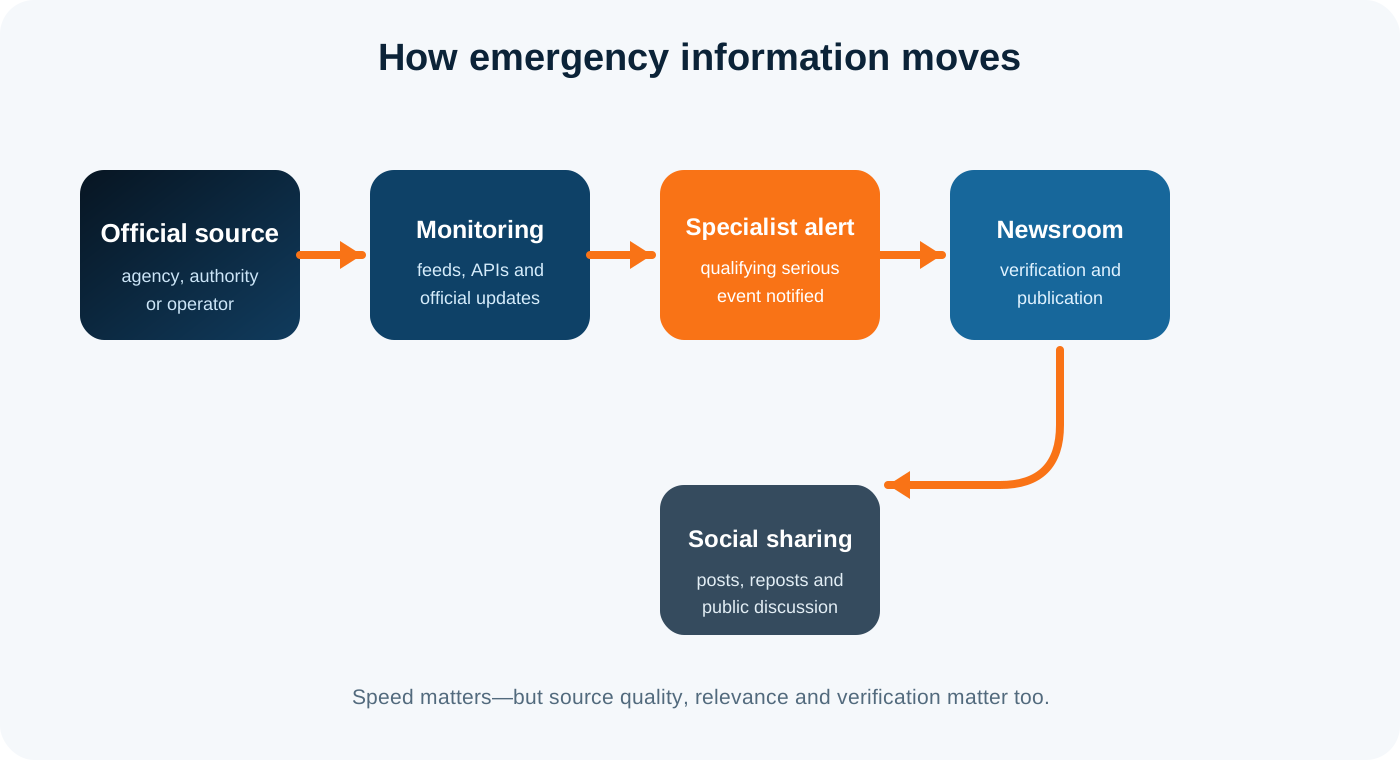
When a large earthquake, flood warning, wildfire, transport emergency or major outage appears on a news website, the underlying information has normally already travelled through several systems. The event may have been measured by sensors, reported by an emergency service, published by a government agency or acknowledged by an infrastructure operator.
Journalists then need to understand what happened, establish where it happened, judge its significance and confirm that the source is genuine. Only after that work can a clear headline, article, live page or broadcast be produced.
That editorial delay is not a failure. It is part of responsible reporting. But it explains why an automated or closely monitored primary-source alert can sometimes arrive before a conventional news report.
Where emergency information starts
The original source depends on the type of event. Earthquakes may be detected by seismic networks. Flood warnings may be issued by national or regional flood authorities. Severe-weather warnings come from recognised meteorological organisations. A large electricity failure may first be acknowledged by a network operator. Government emergency alerts may be issued directly to compatible devices in a threatened area.
Many of these organisations publish machine-readable feeds, official webpages, bulletins or notification services. The US Geological Survey, for example, provides real-time earthquake feeds and automated notification options. The UK Government’s Emergency Alerts system broadcasts messages from mobile masts to compatible devices in an affected area.
How newsrooms learn about emergencies
News organisations use a combination of official statements, agency feeds, emergency-service information, specialist data services, local reporters, eyewitness material and direct calls to authorities. Major newsrooms may have journalists monitoring several channels continuously.
Even when the underlying official update is already public, a newsroom usually needs to answer several questions:
- Is it genuine? The source, account, document or feed must be authentic.
- Where is it happening? Early place names can be vague, unfamiliar or mistranslated.
- How serious is it? A technically large event may have limited impact, while a smaller event in a vulnerable location may be more consequential.
- What has changed? Initial figures can be revised as better information arrives.
- What should the public do? Protective advice needs to match the current official instruction.
This verification improves trust and context. It also means the first responsible news report may appear after the first official feed item or alert.
Why social media sometimes appears to be first
A witness can publish a photograph or short video within seconds. That can make social media feel faster than every formal channel. Sometimes the material is genuinely useful. At other times it is incomplete, wrongly located, taken from an earlier event or amplified before anyone has checked it.
Social platforms also mix primary evidence with commentary, reposts, jokes, speculation and deliberately misleading content. During a fast-moving event, popularity is not the same as reliability.
A sensible approach is to treat eyewitness material as a prompt to check—not as a complete emergency instruction. Look for confirmation from the relevant authority, emergency service or recognised technical agency.
How specialist alert monitoring can be quicker
A specialist monitoring service does not need to wait for a complete news article. It can watch selected official sources continuously and apply predefined thresholds. When an update meets those thresholds, the service can prepare and send a notification.
The time advantage comes from removing some intermediate steps:
- Continuous monitoring: official feeds and webpages are checked without waiting for a person to search manually.
- Event filtering: the system tests the update against rules for severity, region and event type.
- Rapid delivery: a qualifying event can be sent by browser push or another notification channel.
- Direct source access: the alert can point the reader back to the relevant official information.
This approach still needs restraint. A service that forwards every low-level advisory or uncertain update may be fast, but it may also create so much noise that important alerts are ignored.
Official alerts, specialist monitoring, news and social media compared
| Channel | Main strength | Main limitation | Best use |
|---|---|---|---|
| Official emergency alert | Authoritative, location-focused instructions for a serious threat | Used selectively and does not cover every event | Immediate protective action |
| Specialist monitoring alert | Can detect qualifying updates from selected primary sources quickly | Coverage depends on monitored sources and thresholds | Early awareness and a prompt to check official details |
| News organisation | Verification, explanation, interviews and wider context | Publication takes time | Understanding what happened and what it means |
| Social media | Fast eyewitness material and local discussion | High risk of missing context, errors or recycled content | Additional observations after verification |
Examples of the timing difference
Earthquakes
Seismic networks can calculate and publish preliminary details soon after an earthquake is detected. Magnitude, depth and location may be updated later. A monitoring service can detect the initial official record, while journalists may wait for confirmation of impact, affected communities and official statements.
Flood warnings
Flood authorities can raise or update warning levels before a local or national news article is written. The warning itself is the important primary information; news coverage can then explain affected roads, communities and wider disruption.
Major power outages
Network operators may publish an outage notice or service-status update before the event attracts broad media attention. For households, the earliest useful information may be confirmation that the fault is widespread and an estimate—where available—of restoration progress.
Government emergency alerts
In the UK, emergency alerts are broadcast through nearby mobile masts to compatible 4G and 5G devices. They are intended for life-threatening emergencies and provide warning or advice directly to people in the affected area. They do not replace every other source of local information.
Why “first” should not be the only measure
An alert arriving thirty seconds earlier is not helpful if it is irrelevant, unclear or wrong. A trustworthy system needs to balance four things: source quality, speed, severity and relevance.
Source quality
Can the information be traced to a recognised primary authority or technical organisation?
Severity
Is the event important enough to interrupt the user, or is it merely routine information?
Relevance
Does the alert clearly explain the affected area, event and time?
The problem of alert fatigue
When users receive too many notifications, they begin to dismiss them automatically. This is known as alert fatigue. It is especially dangerous when minor advisories look and sound the same as genuinely serious warnings.
“Serious alerts. Less noise.” is therefore more than a slogan. A cautious alerting approach should avoid forwarding every satellite hotspot, routine weather advisory or unconfirmed report. Fewer notifications can make the important ones easier to recognise.
How to use an early alert safely
- Read beyond the headline. Check the event type, location, severity and time.
- Open the primary source. Use the official link where one is provided.
- Check whether the information has changed. Early figures and affected areas may be updated.
- Follow local instructions. Government, emergency-service and local-authority directions take priority.
- Avoid amplifying uncertainty. Do not repost claims that you cannot verify.
What Global Emergency Alerts is designed to do
Global Emergency Alerts monitors selected serious-event sources and delivers browser push notifications for qualifying events. The service is supplementary: it is intended to improve awareness, not replace government alerts, emergency services, local authorities or trusted broadcasters.
No service can promise to be first for every incident. The defensible benefit is narrower and more useful: for some monitored events, a carefully configured alerting system can notify subscribers after the primary source publishes but before the first mainstream news story reaches them.
Frequently asked questions
Are specialist alert services always faster than the news?
No. The sequence varies by event, source and location. However, a system monitoring primary official feeds can sometimes notify users before a newsroom has verified, written and published a report.
Does an early alert mean the information is final?
Not necessarily. Early information may be revised as authorities receive better data. Users should check the linked official source and follow current local instructions.
Is social media the fastest source during an emergency?
Eyewitness posts can appear very quickly, but speed does not guarantee accuracy. Locations, dates and context can be wrong, and old material may be reshared.
Do government emergency alerts cover every serious event?
No. Government alert systems are generally reserved for particular threats and locations. They remain important, but they do not replace every other warning channel.
Why do news organisations take longer to publish?
Responsible newsrooms confirm the source, location, scale and wording before publishing. That verification reduces the risk of spreading false or misleading information.
What is alert fatigue?
Alert fatigue occurs when frequent or low-value notifications make people less likely to notice or act on genuinely important warnings.
Should I rely on one alert service?
No. Use several dependable channels: official alerts, local authorities, trusted broadcasters and any supplementary monitoring service you choose.
What should I do after receiving an alert?
Pause, read the details, check the affected area and time, open the official source where available, and follow current instructions rather than relying on reposts or speculation.
Primary sources and further reading
Important note
Global Emergency Alerts is a supplementary information service. Always follow current instructions from government, emergency services and the relevant local authority during a live incident.